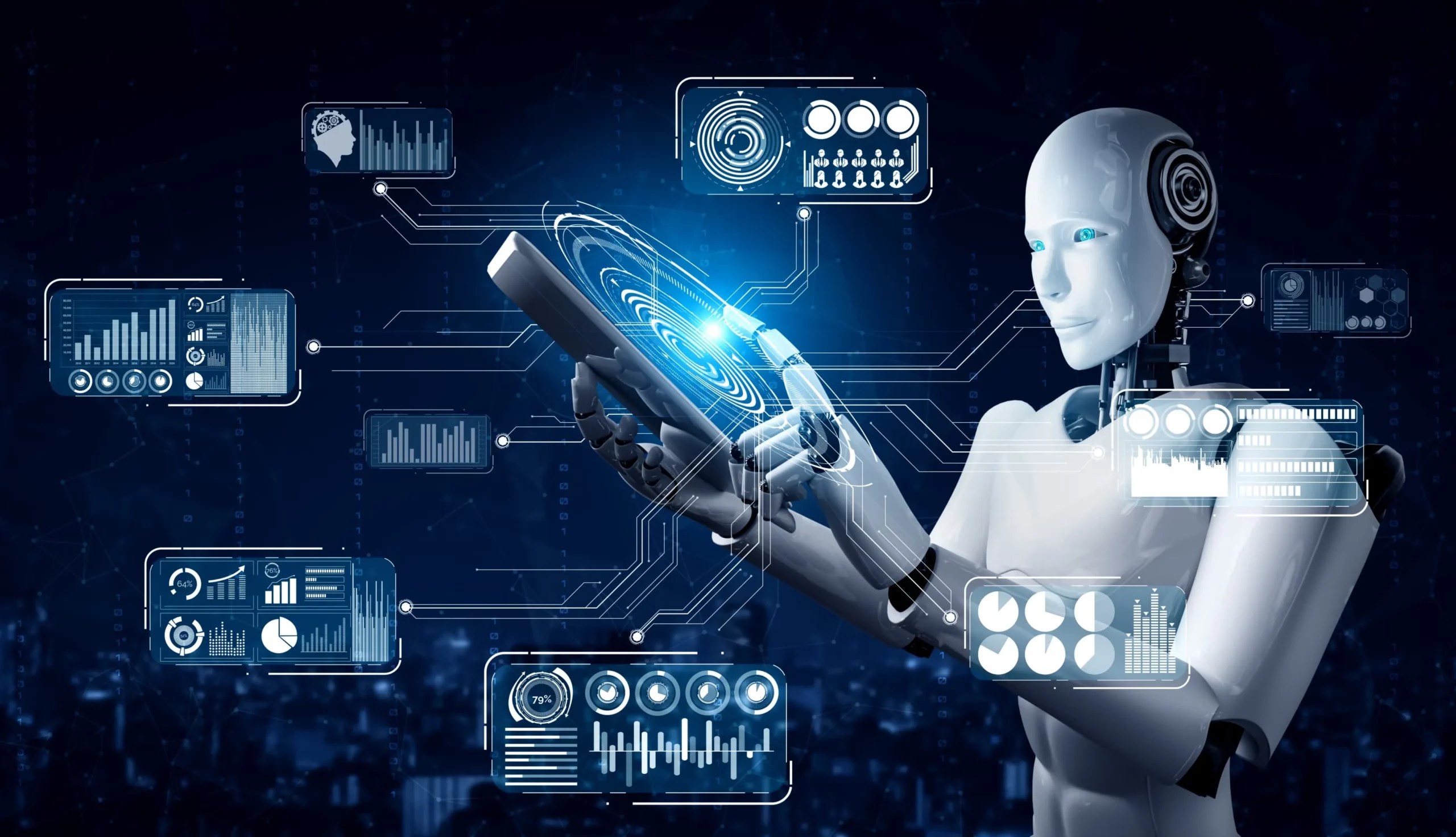
In my last post I examined how artificial intelligence is rapidly transforming the way humans interface with machines—shifting from screens and keyboards to increasingly natural, intuitive, and seamless forms of interaction. But that was only the beginning. In this article, I will continue to turn to the next frontier: AI’s expansion into the physical world. As intelligence moves beyond virtual environments and begins to take embodied form—whether in humanoid robots, autonomous systems, or physical agents capable of perception and action—we enter what I call AI 2.0. This phrase is not merely about smarter algorithms, but about intelligence that inhabits space, performs tasks, and interacts with the physical world around us. Here, I’ll explore why embodied AI represents the logical next step in this trajectory, the technological forces making it possible, and the profound implications it holds for industry, labor, and society.
Central to this evolution is Tesla’s Optimus, a general-purpose humanoid robot designed to perform tasks that are repetitive, dangerous, or undesirable for humans. Announced in 2021 and developed with Tesla’s expertise in AI, robotics, and manufacturing, Optimus represents a significant leap in embodied intelligence. Standing 5 feet 8 inches tall and weighing 125 pounds, Optimus is equipped with advanced sensors, actuators, and AI systems that allow it to walk, manipulate objects, and navigate complex environments. Tesla has already deployed early versions of Optimus in its factories, where the robot autonomously performs tasks such as handling battery cells and navigating obstacles. With plans to begin limited production in 2025 and scale to over 1,000 units for internal use by 2026, Optimus is poised to transform not only Tesla’s operations but also industries like logistics, healthcare, and even personal assistance. As Elon Musk envisions, Optimus could one day be “more significant than Tesla’s vehicle business, ”with the potential to redefine labor by augmenting human capabilities in the physical world.”
Complementing this is Figure 1, a humanoid robot developed by Figure AI, which aims to create general-purpose robots capable of performing a wide range of tasks in human-centric environments. Figure 1 stands out for its AI-driven adaptability, leveraging advanced natural language processing and machine learning to interact with humans and learn new tasks on the fly. With 11 degrees of freedom in its hands and a design optimized for mobility and dexterity, Figure 1 is being tested in commercial settings like BMW’s manufacturing plants, where it assists with assembly and material handling. Figure AI’s recent $675 million funding round, backed by industry giants like Microsoft, OpenAI, and NVIDIA, underscores the growing belief in the commercial viability of embodied AI. As Figure AI scales production, with plans to deploy thousands of units in the coming years, robots like Figure 1 could soon become ubiquitous in warehouses, retail, and even homes—marking a pivotal step in AI’s journey from the screen to the physical world.
In the latest Trends Report on AI Mary Meeker has brilliantly chronicled the vertical rise of AI’s first phase — intelligence in the cloud, on the screen, and at our fingertips. This is an area where global power competition means that America must be a leader in this space. As Mary said in her interview with Axios, “I think this administration has shown an ability to make foundational calls, but then also to change.” There is an unprecedented wave of AI investments in the United States on building out AI infrastructure and capabilities.
As we move forward into AI 2.0, intelligence is stepping out of the screen and entering the world around us: into our factories, hospitals, homes, and streets. This is where embodied AI—humanoid robots like Optimus and Figure 1—mark the next revolution in human-AI coexistence. As artificial intelligence extends beyond the screen into the physical world, we are witnessing the early scaling of embodied AI across industries. Autonomous vehicles now navigate urban streets with increasing confidence, while industrial robots populate factories, warehouses, and logistics centers at accelerating rates. This rapid deployment of machines capable of perceiving and interacting with complex environments signals a crucial inflection point. The underlying architectures—spanning vision, control, and reasoning—are being refined not just in digital simulations, but through real-world feedback loops that allow these systems to learn, adapt, and improve at an unprecedented pace. The physical world is becoming the next great training ground for artificial intelligence.
At the same time, the nature of work itself is undergoing a profound transformation. The first wave of automation displaced repetitive tasks; the second wave, which is now unfolding, introduces AI not merely as a replacement but as a collaborative agent. These embodied systems, whether humanoid or task-specific, are being designed to work alongside humans as co-workers—lifting, transporting, assembling, caregiving, and performing functions once limited to human dexterity and judgment. As these agents grow more capable, entire industries will be reshaped, not through elimination of labor, but through the augmentation and redefinition of what human labor entails.
This expansion into the physical realm also carries profound geopolitical and economic implications. The competition for AI supremacy is no longer confined to software algorithms and cloud platforms. As embodied AI becomes a cornerstone of national industrial capacity, it will serve as both a productivity multiplier and a strategic asset. Nations and corporations are racing to develop sovereign capabilities not only in model development but in the design, manufacturing, and deployment of physical AI systems. Control over the supply chains of sensors, actuators, chips, and robotics platforms will increasingly define global competitive advantage.
At the core of this revolution is a shift in how we must think about AI infrastructure itself. What was once cloud data centers crunching text and images is now evolving into vast AI “factories,” where data, energy, and compute yield not just digital insights but physical actions. These embodied systems represent a form of applied intelligence that integrates perception, cognition, and manipulation in the real world. Just as the internet once redefined information access, embodied AI promises to redefine the very boundaries of work, production, logistics, healthcare, personal assistance, and certainly weapons of warfare—ushering in what may well be the next great distribution phase of knowledge, no longer limited to words on a screen, but expressed in coordinated movement, physical presence, and adaptive autonomy.
As remarkable as these advances already are, they represent only the first signals of a much larger transformation that is unfolding beneath the surface. The convergence of massive datasets, exponentially growing compute power, algorithmic breakthroughs, and sovereign-scale investment is accelerating embodied AI development at a pace that few anticipated even two years ago. What once seemed like distant science fiction—the prospect of intelligent, physical agents functioning alongside humans across nearly every domain of life—is rapidly becoming operational reality. But while the technological momentum is undeniable, it is the emerging architecture of AI 2.0—both technical and geopolitical—that will ultimately shape the trajectory of this embodied revolution.


Leave a Reply